



Emily Kramer is the founder of the wildly popular MKT1 newsletter with over 80k subscribers, where she writes long-form essays on marketing trends, strategies, and tactics for B2B startups.
Before starting MKT1, she was VP Marketing at Carta from their series C through E, VP Marketing at Astro, which was acquired by Slack, and Head of Marketing at Asana, where she built their marketing team from 1 to 25 people.
Listen on: YouTube, Apple Podcast & Spotify
In this episode, we discuss:
Emily’s tips on building & writing a newsletter
How to promote your newsletter
How to get featured on other big newsletters
Where most of her subscribers come from (it wasn’t what I assumed)
What topics and formats work today
How much work it ACTUALLY takes to write a great newsletter
Substack vs beehiiv
Her writing and research process + how she uses Claude Code for it
The Figma MCP workflow she uses to create graphics
Connect with Emily:
Emily's LinkedIn: https://www.linkedin.com/in/emilykramer/
MKT1 Newsletter: https://newsletter.mkt1.co/
MKT1 (advising): https://www.mkt1.co/
Connect with Finn:
LinkedIn: https://www.linkedin.com/in/finnthormeier/
Project 33 - LinkedIn Agency for B2B execs: https://www.project33.io/
Mentioned in the episode:
Kyle Poyar’s Newsletter: https://www.growthunhinged.com/
Lenny’s Newsletter: https://www.lennysnewsletter.com/
Granola: https://www.granola.ai/
Wispr Flow: https://wisprflow.ai/
Attio: https://attio.com/
Hope you enjoy!
Full Transcript:
Finn Thormeier: For someone just starting out with their newsletter, so what advice will you give me?
Emily Kramer: Like most things, like building on or starting a company, like timing is everything. Since the beginning of this year, I’ve been writing a lot about Claude Code, except for a newsletter I did in January, which is shockingly my most popular newsletter, which no one would ever guess is my most popular newsletter. and it’s about running small group dinners as a marketing tactic. I am consistently in the top 20 business section.
I have never, not a single time, had a conversation
Finn Thormeier: All right, before we dive in, you’re listening to the Executive Brand Podcast with me, your host Finn Thormeier. Each week, I sit down with top B2B CEOs, executives, and founders to break down their playbooks. If you’ve not yet, it would really help if you subscribe or follow the show because it helps us get on better guests and create better content for you guys. Alright, let’s dive in.
Alright, I’m here with Emily Kramer. She’s the founder and creator of the wildly popular MKT1 or Market1 newsletter with over 75,000 subscribers where she writes long-form essays on marketing trend strategies and tactics for B2B startups. Before that, she was VP marketing at Carta where she built Carta’s marketing team from scratch while the company grew from 300 to 850 people. Before that, VP Marketing at Astro, which was acquired by Slack.
And before that, Head of Marketing at Asana, where she built, scaled, and led the marketing team from 1 to 25. Emily, thank you for joining. For someone just starting out with their newsletter, aka me, I have 2.6 K-subs.
Emily Kramer: I had 2.6 ones too, you know.
Finn Thormeier: So what advice will you give me?
Emily Kramer: Yeah, I mean, the unfortunate advice is I think it was easier when I started to gain a big following than it is now. So like, like most things like building on most platforms timing is ever starting a company like timing is everything. I don’t think it’s too late to build on Substack. I just think it’s harder now.
So like with that being said, Um much like I think I started on LinkedIn a little too late or like in in you know like with a lot of energy on LinkedIn a little later than some people and that affects things I think it’s kind of interesting I have almost 80,000 newsletter subscribers and I only have about 50,000 LinkedIn followers and there’s a 30k delta and I’m like who are these people I think it’s weird that you would subscribe to a newsletter and not follow them on LinkedIn. Like one’s way more digestible than the really long things, but it is the way it is. But a lot of it’s just when you start on a platform. So with all that being said, I think a lot of the growth, I think just comes from the content and the fact that people can’t find what I’m writing elsewhere.
And that goes back to the long form content thing. I’ve also been the first marketer first-ish marketer first or second four times at various stage B2B startups. And I’ve, you know, led marketing at three of those at different scales as well. And so I’ve been through, like I’ve worked at startups from like seed to very late stage.
I’ve, you know, and now I’ve advised so many companies over the years and invested in about 75 companies. I had a fund. So I had this like perspective as an investor, as someone that’s built marketing teams from scratch and led them at the executive level. And I just think that’s sort of a, Unique Perspective.
I mean, there’s lots of people who have done similar things in their career trajectories, but they’re not necessarily newsletter writers now on the marketing side. And so I think that helps. It’s just like, I think people can feel the experience and the like, I’ve been there and you can tell. And that’s obviously not required for writing a newsletter, but like having a unique perspective and it’s sort of a unique format, I think helps a lot or a niche, whatever it is.
um and so that I think is a huge part of it I think also you know I have done things with other creators I you know go on things like this I’ve done a couple newsletters in Lenny’s newsletter which helps a lot and the recommendations feature on Substack is amazing um so I don’t know I should I should know the answer to this I think it’s 30 to 40 percent of my subscribers on Substack come from the recommendations feature from other newsletters recommending me but That Feature Didn’t Exist When I First Started Out so that isn’t that is something that’s advantageous if you’re starting out now but that’s been a big help as well and then also just like consistently posting on LinkedIn and but I have never I’m a bad marketer when it comes to like for my newsletter I’ve done a little bit of SEO and AEO stuff But not that much I’ve done no paid anything ever It’s just been organic And primarily Driven again through referrals Shares, word of mouth, all that stuff The other advice I guess That’s not advice, it’s more just how I grew I don’t know that I have that much advice Besides find your niche Find your area Get those first true fans I think the other thing that I think is a huge advantage for me Is my newsletters are incredibly visual as well as being long. If they were just that long and they didn’t have diagrams or images, I think it’d be really hard to follow. And most people probably just scan through the diagrams and I recognize that. But that also makes it really shareable.
And so I’m someone that loves to design. I love to spend time in Figma. And if you look at my newsletters, you’ve seen me get better over the years that I’ve done this. This design has gotten so much better because I’ve just self-taught in Figma and other design tools a while ago and Reviewed a lot of things in my marketing leadership roles and always like design but have just like become a designer over time so I do that stuff myself too but like find something like that that can help you stand out or like a very distinct style in those things and so it’s all about it’s the same as growing really any company it’s just like find your niche find your core audience and expand from there well and have other people and have other people recommend you
Finn Thormeier: Yeah. Have you always written biweekly? Like was that the cadence from the start?
Emily Kramer: No, no. The cadence early on was like whenever the hell I felt like it. So very sporadic at first. Like I feel like it was like one or two a quarter.
I don’t know for how long. I should know these things because people ask me about this a lot, but I don’t. But like it was very sporadic for a while. And then it wasn’t until later that I started doing monthly.
So it was monthly for a while because I had a... A small VC firm with my business partner, Kathleen, who I mentioned, who’s now at Pear VC. But we had a small fund and we would invest alongside leads in early stage rounds and then help the companies build out marketing. And so that takes up a lot of time.
We invested in 35 companies in just under three years and so huge amount of time. So it wasn’t until I decided I want to like Double Down On Sort Of The Creator Creator Stuff As Well As Advising And Do Some Angel Investing But I’m Not A VC Or I Was A VC But I’m Not A VC And I Knew I Wanted To Sort Of Refocus Back In That Area I’m A Marketer This Is What It Comes Down To And So Since That Focus Back I’ve Been Writing Every Two Weeks But Like There’s No Way I Could Do It Every Week At The Length That They Are with the same quality and voice and things like that. So I guess every two weeks it will stay.
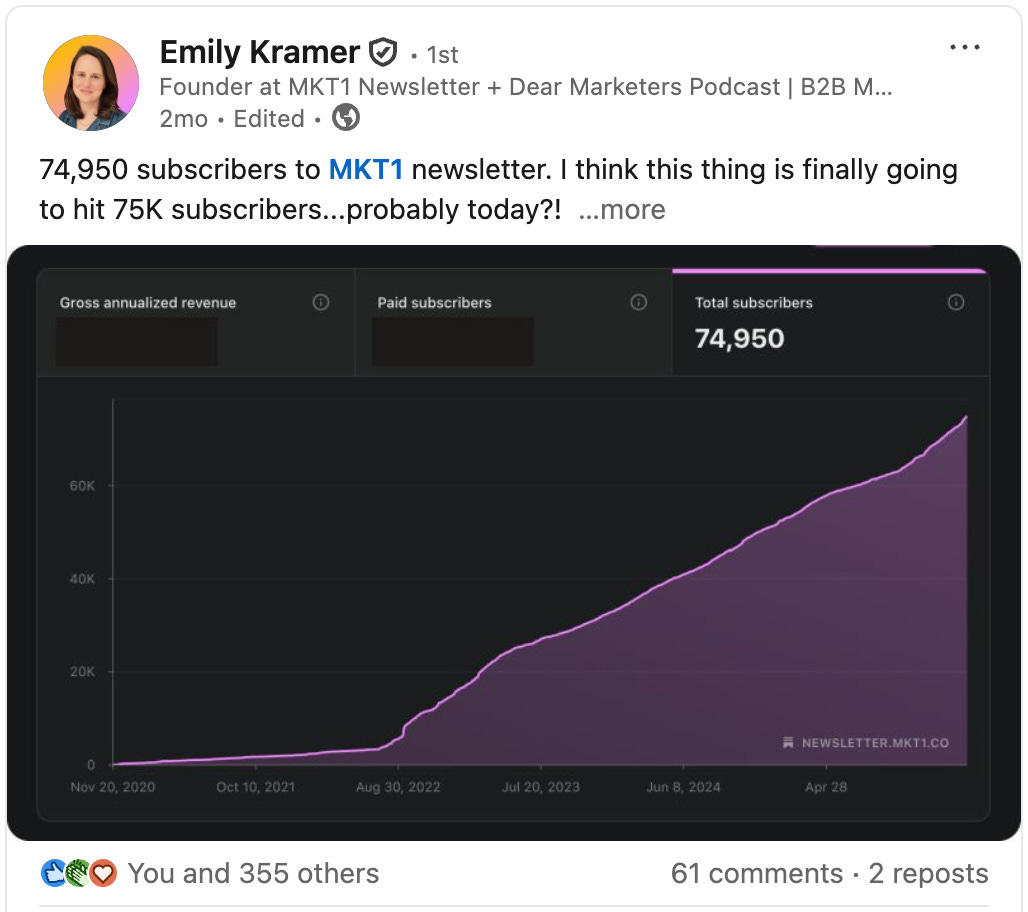
Finn Thormeier: Is this what happened? Because I saw you posted about this I think last month. Let me share my screen. Here it looks to me like the slope of the curve changes.
Emily Kramer: Yeah. Well, yes. So what’s interesting is that spike is in August of 2022. It’s I know that I did both a newsletter and podcast with Lenny, which is a of Lenny’s newsletter, but not until September of 2022.
So I think I’m I don’t I need to like, again, like I don’t have it. But I mean, this might be the spike that I don’t even know.
Finn Thormeier: Yeah, that’s a step change.
Emily Kramer: Yeah, but it also been more. But like, it’s and it’s also when I started writing more frequently, probably when I started monthly. And then You know, it’s kind of just a straight, it’s kind of just linear for a long time. You’ll see little dips.
It’s because every time you send a newsletter, you get a little dip or I get a little dip and then it jumps back up and like compensates for it. But you’ll see a lot of those little like, because you just like scrubbing the list and people unsubscribe. They forget they’re subscribed. I’m over it.
And then the, and then if you look, there’s a, there’s a change in the slope recently. And that is since I started writing about Claude Code a lot.
Finn Thormeier: It seems like that’s the only topic.
Emily Kramer: That’s the only topic. Yeah. And you know what, like I get it like that’s top of mind for everyone. They’re trying to figure out how to get their team to adopt even if they’ve adopted.
They’re trying to figure out how this fits in with all the other tools that they have. They’re trying to figure out how to like, make time to go get that all in place while they’re doing everything else. And so I think it’s top of mind. So You know whenever I like you know for for me it’s like whenever there’s a big shift in marketing or like a big change or something that’s top of mind for everyone it actually makes my job a lot easier like I know exactly what to write about if I want to have it be successful but what’s really interesting is for the past I don’t know what is it since the late fall I’ve been writing a lot Since the beginning of this year I’ve been writing a lot about Claude Code but I’ve been writing pretty much exclusively about AI for a while like some AI that’s except for a newsletter I did in January which is shockingly my most popular newsletter which no one would ever guess is my most popular newsletter and it’s about running small group dinners like as a marketing tactic that is my most popular newsletter by views ever even the early ones I had like an early one on an org chart that did really on org charts that did really well Like that’s that’s the best one I’ve written and it was with this person Sheena who runs dinners for companies and it was honestly one of the fastest ones to write it was not a 40 50 hour one and uh people liked it the most and I think part of that is because like people outside of marketing also run these dinners and nobody it’s kind of like a basic topic and no one really writes about it with any sort of like point of view.
So I guess that was it, but it wasn’t about AI at all. So the spike is due to writing about Claude Code, but the best newsletter ever is actually the least AI of them all, which is running dinners.
Finn Thormeier: Well, but it’s also kind of about AI because it’s the counter movement when everything is so crowded and noisy, the real stuff still works, right? The human stuff works.
Emily Kramer: And I mean, that’s the whole point in the intro of the thing is why going back to sort of events and going through partners and human things work. So certainly it is, but it’s not as directly, it’s like kind of the inverse. So it’s just, I find this, I want to almost write a newsletter about how it’s my most popular newsletter because I find it kind of wild. I write like so much about like strategy and things like that.
And like, yes, it’s interesting, but at the same time, it’s also just a dinner. It’s not that interesting. So I think it’s just, I like to talk about it because I think it’s such a weird, it was a shock, so.
Finn Thormeier: From that, were you like, oh, therefore I should make a newsletter about X?
Emily Kramer: Um, I think the thing that I constantly have to remind myself is like, I think about marketing at this point in sort of a more probably academic way than, or like removed zoomed out perspective than most people, even though I’m marketing my own stuff. And even though I’m advising marketers who are very much in the weeds and going in the weeds with them and all of these and have led teams for, you know, 15 years in house or 10 years in house. I, I think that I like to talk about like the strategy and the theory and so many marketers are just in it right now and they need like tactical help. And so if anything, it reminds me like, don’t forget about the basics because people still need lots of help with that.
So I don’t know if it like really like I write where like the conversations I’m having like you couldn’t write a newsletter for didn’t advise companies I write where like the conversations take me I make a roadmap and then I throw it away. And if I don’t feel like energized by the topic, I’m not going to write about it because I think you can tell. So it doesn’t really dramatically change things.
Finn Thormeier: Besides the Energize, I mean, how do you pick the topic, especially given that you only write every two weeks, you kind of have not only it feels like all the time.
Emily Kramer: No, I don’t have that many slots. And I tell people that a lot. I mean, I was just talking to someone yesterday. And I was like, Oh, we should I should interview you and we should like write something.
And then I was like, but I can’t do it until August. Because they Because I don’t want to do too many I try to mix up the kinds of things And so those spots where I talk to smart people all the time And now I do this kind of thing where I interview people And so I don’t want to do everyone like that though Yeah, they do fill up But I also change my mind a lot And change up what’s happening I am not the kind of person that has Like five newsletters halfway done Like I very much like completely go into focus mode The newsletter I just wrote which is now going to be a three part series which I did a bunch of research and clawed on a hundred startups and a hundred data points started by just trying to answer a question for an advisee and like blew it all off and that is not at all what I was going to write about and now it’s a three part series so we like added an extra newsletter in move some things back but it’s pretty um so I will change my mind even like when I start writing sometimes So it’s kind of the advice I give marketers. It’s like make a plan so that you, for the sake of really thinking through what’s going to work and things like that. But then like, don’t be afraid to break the plan if something else better comes along.
So I kind of do that exact same thing. But again, it takes a shit ton of time. So I have to feel like, you know, once I start for like three hours, if I don’t want to spend the other 20, I got to switch.
Finn Thormeier: And then you just throw out the work of three hours.
Emily Kramer: I’m trying to think if I’ve ever gone back to any of those I’ve gone back I’ve gone back sometimes I’m just like not in the mood or I feel or I realize oh I need to do some like more research on this or I need to talk to some people about this topic or oh it’s not an interesting point of view I mean I should I should try to go back to all of the like random drafts that I have and just write like mini write at least LinkedIn posts about them but um yeah I throw things away
Finn Thormeier: It wasn’t an hour question but now I’m wondering like what I assume you can’t really write a newsletter in like 30 minute bursts right so do you have like big chunks blocked off where you just do writing you don’t check email you don’t check nothing
Emily Kramer: yeah people can probably tell I’m definitely in like a week or two of life where I haven’t where I’m like behind on LinkedIn messages like crazy and emails like crazy Because I was like spent forever on this report that I did and also was sick so it just moved things back but yeah I try to concentrate advising on to like a single day of the week but it doesn’t always work like I try to have it all on Tuesday but I have like a straggler Thursday repeating one but I try to do that and then I try to have the end of the week more free for things that come up and to write but like the truth is and I don’t recommend this and I’m not an advocate for people working a 996 or working seven days a week but I do the vast majority of the writing on the weekend because I can’t like because I need to just be like totally focused um and get in the zone the things that I do like throughout the week like the design stuff and like some of the research stuff or like things like that I can do sporadically and in between but actually like structuring the thing
Finn Thormeier: um what’s the minimum block that you need to do good writing
Emily Kramer: the thing is is like I don’t I’m not really like the writing is not it’s the writing is easy the writing is not what takes a long time the thing that takes a long time is like Structuring it and what is it and how is it structured and what are the diagrams because that’s where I do my thinking and then the tweaking of those things is easy but what are the main assets I usually write an intro and then I write the thing and then I usually come back and dramatically edit the intro and then the conclusion is the eleventh hour like the end part I don’t know if it’s a conclusion but it kind of is And so I think that people would be surprised how, maybe they wouldn’t, how diagram driven the process is. Like how much I do the visual stuff as like, I spend more time on it than the writing. The writing just like, that’s not, that’s not the hardest part. It’s the structuring and the diagrams and all the things around the writing.
Just writing words at this point in time. I mean, it takes time, but it’s not that time consuming.
Finn Thormeier: You, you, you’ve, you’ve ever tried, you know, using Claude or ChatGPT to write parts of it.
Emily Kramer: Oh, for sure.
Finn Thormeier: Speak into Wispr Flow.
Emily Kramer: Yeah, I was gonna say, I do some speaking into Wispr Flow. Um, I don’t know. This is so like, this is so like in my process, but I think it’s interesting to hear about people’s creative processes. So hopefully this is interesting.
Yeah. I, um, feel like typing makes me think like, I think more when I talk very fast I’m like I don’t feel like it’s as good when I write it I do do it sometimes if I feel like I can’t get the structure right I’ll just talk for a while and then have it help with structure I’ll do it sometimes but it’s usually just for pieces of it not the whole thing I’ll be out walking my dogs and I’ll be like oh this is what I should do and I’ll voice record But not like the whole thing. It’s just not, I just feel like I think with writing, like when I was like in school to memorize things or to learn, like I didn’t learn by listening. I didn’t, I just had to like go through and make like one page cheat sheet and write it down.
And then it was in my brain. And I feel like it’s like that. So, um, I’m not a bit, I’m also a very fast typer, special skill. I do use Wispr Flow, but I don’t even know what my words per minute is I bet it’s like I bet it’s like I bet it’s like I bet it’s like 90 to 100 I think it’s pretty fast
Finn Thormeier: We should play a TypeRacer Yeah It’s a website It’s a great game I feel like most people are like that though I think that’s why that’s why voice notes are so annoying because people send you a voice note when they don’t really want to think through what they have to say and it’s just a three minute ramble where if they had to just sit down what they want from you it takes them longer but it’s a much shorter message right
Emily Kramer: Yes. That’s why it’s useful for distilling structure. If I talk about it, what order do I talk about it in? And the thing I do a lot is I’ll have a conversation.
Often I have the newsletter topic in my mind and then I find myself talking about it that week to people I’m advising. It just comes out, this idea. And so I will take my Granola notes and stick them into Claude a lot. So it’s just kind of different with each...
Topic, but I’m like a people might think I’m organized. I’m not like it’s like a it’s like a it’s like a if you if you saw it in the middle, you’d be like, this is never going to be good. You would just be like, what is this?
Finn Thormeier: So how are you using AI? I mean, there’s the research you just you’re publishing your three part series where you had Claude Code analyze very research.
Emily Kramer: I am using Claude Code for a number of things. I use it again like if I do have notes or a mess and I just need to like figure out the structure and the sections I’ll like slot that in I don’t really use it for drafting the whole thing like I don’t start with like an AI draft I’ve tried it just doesn’t I’ll go section by section and sometimes I’ll have it be kind of messy and I’ll have it like structure that it’s changed a lot in the last few months just with like making tons of skills in in Claude Code. I exclusively use Claude Code now. I don’t even ever really go into chat.
I just do it all in there. But I also use it to add links, which is really useful, like links to all of my old newsletters and links to certain companies like I have some affiliate partnerships so I make sure those links are in and a number of things like that and to check our newsletter sponsorship links so that’s a big one that just saves time at the end I have a copy editing skill that saves time at the end my team still reads it through Katie and Hallie is my team who work part time for me but Katie and Hallie read it through for a human perspective but a lot of the copy editing and things like that are happening in there so I use it for subject lines it’s made me better at subject lines because I get like cringe about some subject lines and I just like I’m trying to get over it and just do what it recommends um and it does help uh but yeah I’m using it for pieces like I’ll take a piece of it and be like can you clean this up or can you make this paragraph tighter it’s a lot of that um like I wrote this thing make it make it tighter so that’s what I’m using it for it’s it’s definitely like a Thought Partner at the beginning too or like gut checking things that I think does this make sense like but it’s definitely like iterative not like I’m spitting out a draft and then editing it what do you think it has I would be so interested to watch someone else try to write like that writes a newsletter how dare use it in their process and if it’s the same
Finn Thormeier: How do you think it’s changed like when we if we think about let’s say the ROI question because you say you still spend a ton of time it’s not like you’re now oh I cut the amount of time I spend per newsletter in half what do you think has been the output of
Emily Kramer: I think I spend less time I think I spend actually more time on the content like in what’s interesting and maybe I spend more time on like the things that go with it or like I am able to do bigger like research reports or um or I am like making skills for people now which then like because we have an MCP server we’re pushing a lot of skills through it through it we’re one of the first newsletters to do that and like I now spend time making those for people too so that’s part of the process so I think I’ve just added I think they’re more valuable now honestly yeah um I mean I and I think they’re longer they just get longer and longer so I I do think it Like it’s annoying to go in and add links. Like everybody knows that it’s annoying to go in and check the links. Like I don’t have to do that stuff anymore. So it gives me more time to spend on the other stuff.
Yeah. The one big lift for me is like I’ve gotten in the past month. So I do all the, you know, design and Figma myself. And I like to do that.
Like I wouldn’t give it away. It’s like meditative for me almost, but I’ve gotten pretty good at using Claude with the Figma MCP server or the connector and Using that to go in and write all the headlines for the diagrams and have an update. Or like the graphs I just made. were all made in Figma with the MCP server.
I would make the initial graph what I wanted to look like and then it would fill in all the data and update all the data if the research changed. I’ve gotten that workflow through mainly doing this report with all of these graphs. I did 19 graphs in one newsletter and I used the Figma MCP for all of it and I’ve gotten so much better at that. I think that’s going to speed things up a lot.
It’s not going to take the fun part out of design, but it’s going to take the repetitive stuff out of it. I think that’s going to help a lot, but I’ve just learned. A lot of this stuff like I’m just putting in place right like I’ve just made all these skills I’ve like just had it all like flow together like we’re just figuring out the workflows on that internally on like how we’re changing the editing process because of some of this stuff and so it’s all like a you know I think the dividends will pay off um yeah down the line um
Finn Thormeier: I’ve seen a bunch of people recently switch over to beehiiv I think Kyle Poyar
Emily Kramer: yes people like to ask me this question he did
Finn Thormeier: What’s your thoughts? Have you ever, you know, gotten tempted?
Emily Kramer: Okay, here’s my Substack story. I have been on Substack. You said, when did you say I started?
Finn Thormeier: The fall of 2022.
Emily Kramer: Years. I am, like, consistently, like, in the, you know, top 20 business section. I have never, not a single time, had a conversation with anyone from Substack.
Finn Thormeier: How have they not reached out to you?
Emily Kramer: Not a single time I went to they had a holiday party a couple of years ago and I went but not a single person from Substack still talked to me I talked to like other newsletter creators that were really interesting and like my partner came because it was like very like a holiday party um but yeah still I’ve never talked to someone that works there not not even in life um and I think that’s crazy um and I think it’s like I’m just gonna say it’s really bad Customer Support and when you write in it takes forever to get an answer and I think it’s terrible and I don’t know what they’re doing and so like I’m not even afraid to say that because I’ve never talked to anyone there to even feel like I have a connection to it so I don’t have a lot of connection to it watch they’re gonna like you’re they’re gonna like push me down the list but I’m happy to talk to someone there I have a lot of opinions but the reason I say is because of the recommendations feature and that drives so much of my growth and You know, until some of those other people move off the platform. I’m not going first. I mean, Kyle, I guess, went first. I’m not going second.
I’ll go somewhere in the middle. But the thing that is going to kill them is they don’t have an API and they don’t have an MCP server. And so we do a lot of authentication for paid subscribers. This is getting like into the weeds, but it’s interesting.
um we do a lot of authentication if you’re a paid subscriber you can get our MCP server you can access our like deep discounts on things you can post on our job board and so we authenticate and we had to build build that authentication off of Stripe billing so Substack doesn’t have an API but Stripe does um and the billing through Substack is all through Stripe so we can see who’s paid and who’s stopped paying And so we feed that into a database and then we use that to authenticate. So we’ve hacked a membership API off of Stripe for Substack. And that’s just crazy. So I don’t know what their strategy there is, but I’m pretty, I’m almost positive.
I don’t know exactly where they are in the whole MCP server cloud universe, but I’m almost positive they have an API. I mean, I do own my list in Substack, but... It’s just like that’s where things are moving so I’m interested to see if they change that and catch up so that’s like my biggest that’s my biggest gripe like it’s not actually a gripe that I haven’t talked to anyone there like whatever like it’s just funny I think it’s just an interesting fact and then I think it’s it’s the that’s the killer is just it’s really hard to run like a membership based business off of their platform. And so I think there is room for companies like beehiiv and we’ll see what happens.
I don’t think Substack is the best product at this point in time at all. I just think it has the network effect.
Finn Thormeier: I mean, if beehiiv is listening to this, I would be reaching out to a certain someone right now.
Emily Kramer: I mean, no, it would take a lot on the recommendation stuff. It drives so much for me. But, you know, I think the lesson for marketers is this. uh how your company treats customers manner you should like filter filter that like when you’re trying to pick pick a company and push for that and then I think also um the the AI strategy obviously manners but if you have a network effect or like virality I mean they have a network effect with the recommendations feature if you have that and also with just people subscribing and wanting one place for all their subscriptions If you have that and you are not spending a lot of your time trying to accelerate that network effect, you’re doing it wrong.
If you have any potential for a network effect or something like that, you as a marketer need to be helping to accelerate that. Market the recommendations feature, those kinds of things. I’ve seen this firsthand at Carta. There’s a network effect at Carta.
Asana some might say it has a network effect but they’re really like internal most people don’t use Asana with guests and stuff but like if you have I see so many people just not like they’re like oh we kind of have a network effect I don’t really know I’m like if there’s any hope that’s just going to make you grow like crazy and so if you have I call these like marketing advantages and a network effect is by far the best one and if you have one of these things in this case it’s like a business advantage not just marketing like Double Down Like Lean Into The Advantages Don’t Fight It If You Have A Network Effect Don’t Spend Forever Doing Like Cold Outbound If You Have A Network Effect Like Don’t Spend Forever On Paid Search Like Just I Mean For Maybe For Brand Stuff In That Case But Just Try To Accelerate The Network Effect Try To Accelerate The Actions That People Take That Drive Other People To Be Notified Like All Of These Things And So I mean it’s just that’s that’s really the lesson for marketers is like the power of a network effect or an extreme advantage and even the best product or even without the best customer support can can remain on top
Finn Thormeier: we’ll get to the kind of second part here I know we’re spending a lot of time on the newsletter but I think it’s
Emily Kramer: no it’s interesting nobody ever asked me these detailed questions so it’s interesting to think about some of them so yeah that’s good it’s different
Finn Thormeier: I have two more questions here one that when I was looking at beehiiv and Substack and trying to decide one of the things that made me go for Substack was that I saw there’s this home feed and and and people post notes there too which is kind of like Twitter or threads and I saw some of them even go viral but since then I haven’t really used that how do you use it do you use it is it a is it a major thing for you or not
Emily Kramer: um I use it I always think I should I’m always like I’m gonna use it more and then I will post like for every newsletter I’ll do like a post there but I feel like the things I have success with there like because I have a you know paid subscribers as well as free I mean a vast majority are free but on the paid side But that’s not really the notes, that’s more of the chat. You can communicate with paid subscribers pretty well, or people that are paying the most attention to your newsletter will respond to notes. For me, there’s only been one or two notes that have driven any sort of meaningful subscribers. And when I say meaningful subscribers, I mean there’s a couple of notes that have driven over 100 subscribers, which at the scale that I’m at is not significant.
And you can go viral, but the thing that works the best in Substack Notes is talking about your Substack growth. So it’s very like inside baseball right now like it’s very like like like that graph you know like that you shared of my subscribers like that that’s gonna do well in Substack Notes um it’s it’s just like the people reading they’re not necessarily
Finn Thormeier: I mean for you that might be still more overlap than for others because it’s
Emily Kramer: yeah marketing
Finn Thormeier: yes interesting Do you read it? Do you go there and read and learn and discover?
Emily Kramer: I mean, I’m certainly subscribed to other newsletters. So I go into Substack a lot because I’m a numbers person and I like to, I just talked about how much I love design, but I’m actually a numbers person more so than anything else. And so I like looking at the numbers and how things do and all that stuff. So I go in there a fair amount and then it’s there.
So maybe I’ll look at the few things, but I’m not scrolling through it like I would. Yeah. Um, but I mean, Hey, like, I think it is another, some people are making it work. It might work better for some, you know, some people than others.
Um, I wonder if I like really committed to it and did it like two or three times a week, like I do LinkedIn, like how it would work. But I think the visual, it has to be shorter than LinkedIn.
Finn Thormeier: Honestly, I think where my mind goes, your thing works because you spend so much time actually working on the newsletter, not promoting it, right? It’s like kind of the, you just create a good product and obviously you put it out into the world, but you don’t do all the hacky things around it that you probably could be doing. And I feel like if you would start doing them, exactly, then you had to deprioritize actually writing The Newsletter and it would be worse and then it would be a net negative I feel like
Emily Kramer: yeah I mean I um it’s it’s just purely a time it’s purely a time thing and I have like an aversion to doing because it’s me um I just like I have a really like I just like even like I was talking about like subject lines like I don’t even like optimize them like I would for a company because it’s just me and it needs to sound like me and I don’t want it like someone sees it especially that knows me which like a lot of people that I know are subscribed to this like if it’s cringy they’re gonna be like it’s just it’s it’s me and that doesn’t feel right so I have like a lot of like issues with sort of some of the authenticity so there’s some things that I just can’t do like super clickbaity stuff like it works for some people whatever do it But uh I just can’t and then some of the like growth hacky stuff behind the scenes like I just haven’t had I just don’t have time
Finn Thormeier: so now on the on the recommendations because you said it drives a lot of growth did this just happen organically or do you have conversations with people who are like hey I’m gonna recommend you you’re gonna recommend me let’s do this thing
Emily Kramer: I have never reached out to anyone and asked them to recommend me. I’ve had a lot of people reach out to me and if I know them or I think their stuff’s good or whatever it is, or I think it’s a similar audience or whatever, I will quid pro quo it or whatever. I will give it back. I will do that.
So people ask me and I take those requests seriously and look at them and can go both ways. um but most of it is just sort of organic and there are certainly like you know big I feel like creators on Substack try to help each other out like I don’t feel competitive with other people um maybe you do I don’t like I don’t feel you know Kyle has a big audience and growth there’s a ton of overlap I don’t feel competitive with Kyle. We always have planned to do a report or something together. Timing hasn’t always worked out, but I don’t feel competitive with him.
You mentioned that name, so I’ll use that name. I just think people are going to read multiple things. People are going to consume lots of content. It doesn’t have to be from like one singular person.
And so I just see it as like, I’ll recommend you, you recommend me. Let’s grow together in this weird universe that we’ve cultivated for ourselves. And I am the most competitive person you will ever meet, but I do not feel competitive about this. Maybe I’m not the most competitive person you’ll ever meet.
Finn Thormeier: On guest posts, because you said Lenny had you featured around that time when your slope changed. How does that happen? Do you reach out? Do you just wait and hope that someone discovers you and reaches out to you?
Emily Kramer: In these situations, I actually know Lenny from doing First Round Angel Track years ago, which is their I think it’s like their angel investing cohort and so I did that right when I was because when I started like I started advising and angel investing and then like kind of the newsletter came later and so through that advising angel investing world I met a ton of people and through my ears at startups so a lot of the people that are like the big creators maybe not as much in product but like the big creators at least in like marketing growth I knew or had met prior to newslettering. Not Kyle. But like, you know, or we’ve been in, you know, at least the people that have been around for a number of years. Like I’ve been in the Bay Area for 20 years.
Like I’ve worked in startups for a really long time now. And so I just feel like you get to know a lot of these people
Finn Thormeier: So you’re saying it’s a mafia It’s a cartel You all know each other
Emily Kramer: I don’t feel that I don’t hang out with those It’s not like I’m hanging out with those people on the weekends I just feel like there’s a certain At least a certain time of when we started on Substack I feel like I know a lot of those people And I don’t really know how it happens It’s just one of those things where You’re doing a panel discussion And they’re there Or you’re I don’t know that just it just happens I feel like for at least in my universe because of the time spent I feel like I have a lot of these connections but I am not someone that is really going to reach out and ask and pitch again like I am much probably better at marketing a company than marketing myself Like I, I, you know, it sort of happens like in conversations about other things that these things usually come up.
Finn Thormeier: So let’s say someone listens to that and they’re like, I want to be featured on the Market One slash MKT One. We don’t know how to say it. What do you think like, and you don’t know them. Do you have, has that ever worked?
What would they need to pitch you?
Emily Kramer: Yeah, it did. It did work. Um, I did something with Casey from DoWhatWorks on web trends recently. And I knew Casey just from commenting on each other’s LinkedIn forever.
And so in that way, I knew them, but I was interested in a lot of the things that he was posting about web. We had a conversation. I was like, let’s do something together. And we chatted about that topic and pulled a bunch of his examples.
And that’s how that happened. Talk to him. Watch. He’ll be like, watch.
No, well, I don’t remember. I think he might have messaged me on LinkedIn and be like, we should chat sometime. And I was like, oh, great. I know your content.
So I think he might have reached out for I don’t really know but I didn’t know him and we had a conversation that wasn’t necessarily about that that led to that and it was just from commenting on LinkedIn and so I think a lot of people I mean that’s how I like I knew who you were because I follow you on LinkedIn and I’ve seen your stuff so when you reach out or like do a podcast I’m like sure so I think there’s a lot to be said for commenting on people’s LinkedIn there’s certainly people that I feel like I don’t know but I know who they are because of consistent engagement with my Content and things over the years and there’s certainly names that I recognize and if they reached out to me and said hey is it possible that we could do something together I would say yeah what’s your idea um so I think it goes a long way to like knowing people could just be that I’d like seen their name interact with my things before um so
Finn Thormeier: And I assume the idea would have to be something where you feel like, yes, this is totally relevant to my audience. And I personally do not have the expertise, data, whatever, to be able to write this myself.
Emily Kramer: Or I just think it’s going to add an interesting angle to have a conversation with you. Or I think it’s going to speed up my process by having a conversation with you. Um, or like, I think having two viewpoints on this might be interesting. So, I mean, it does, when I do interview someone who’s an expert, it does speed things up in the vast majority of cases.
Um, because I write it myself when I use, if, if I, I’ve had a couple of like guest posts and those take longer. Um, if someone else is writing it and I have to edit it, cause it’s just like 10 layers of awkward, someone you respect editing their content, I find to be incredibly awkward, but you want to put it in your voice. And so I, Me interviewing someone and then writing and then getting their approval and edits, you know, works pretty well. So that’s what I’m doing more of this year.
I’ve done like almost half of my newsletters this year have been that way. So I’m trying to do one newsletter just completely me and then one is sort of that. Um, and so you got to switch it up, but I think that speaks to what’s working in marketing in general right now. Um, to your point earlier, which is like what I call ecosystem marketing or ecosystem growth, which is leveraging third parties that have credibility and reach with your audience partners is another word for this and using them to help you grow.
And that works like, you know, a lot of our inbound outbound things we’ve been doing for years aren’t working, but going through people that have credibility, whether it be like You Know At Carta We Grow A Lot Through Lawyers Which Lawyers Aren’t The Customer But They’re Partners And They Have A Lot Of
Finn Thormeier: Yeah It Makes Sense
Emily Kramer: And So You Know We Went Through That Like There’s Companies That Go Through Agencies As I Mentioned There’s Also Like Influencers And Creators There’s That You Can Sponsor And Partner With There’s Complimentary Companies That You Can Throw Events With Like Any There’s Tons Of Types Of These Partnerships And so working with other people is one of the big ways to grow right now. And so I’m trying to do more of that myself too, right?
Finn Thormeier: Because every single person you feature will share and re-share.
Emily Kramer: Or people will know who they are. Or even if they don’t have reach, because a lot of times I’ll be writing with people who don’t have the same Reaches Me, but they have a lot of credibility on the topic. And so it does help me cover more surface area or speak to topics in deeper ways. And so I’m not just looking, and I think this is the same for companies too.
I’m not just looking for, do they have more reach than me? I’m looking for, do they also have credibility in an area where I don’t or where I’d like even more credibility or where it’s just interesting. And so it’s definitely needs to be like a formula of credibility and reach and just like how well you collaborate with each other, right? There’s certainly people that I find really interesting and I like their content and things like that, but I don’t think like would be the best collaborator for me.
Finn Thormeier: Yeah. Now I guess this podcast will end up just being on kind of your newsletter on audience.
Emily Kramer: I don’t want it to be. I can talk for, I am a talker. So you’re just, you ask me questions.
Finn Thormeier: I’m going to go to the other side. Why did you add the podcast? Why did you add the podcast? And what happened to it?
Emily Kramer: Um, I added the podcast because I was having a lot of like, I call the same people with questions all the time. And I was like, let me just do a podcast with them and let me try this out. And I was on a lot of other people’s podcasts and I was like, maybe I can do something different here. um and a friend of mine runs Caspian Studios which is a podcast production studio and so I had a lot of conversations with Ian and still do about podcasting and things like that and I was like let me just try this um again because my newsletters take forever and there’s a lot of people that want to partner and sponsor and things like that and like I gotta have more surface areas and so I did it last year I did it purposely as a season-long thing um knowing that I didn’t want to start something that was forever and um because I get bored and I like to do different things and so right now I’m spending a ton of time on our MCP server and making skills and AI training and events that way and I said I would never have a slack but we’re gonna have a slack just for people who use our MCP server to talk about AI it’s very focused um and so uh That is my focus right now.
In addition to the newsletter and advising, I always kind of have one other big thing. And then I’m probably going to swing back around to the podcast in the fall and maybe change up the format a little bit, but probably not a ton. We’re going to do like in person, everybody in person, like video shoot high production if we do it. But yeah, it’s just another format.
Like, again, I get bored easy. I always want to like try new things, see what works. And even if it works, but I don’t like it, I won’t keep doing it. So just trying to like You know Keep experimenting
Finn Thormeier: Now I did want to ask this question Which is not on the newsletter But obviously you do a lot of advising And you talk to Heads of marketing CMOs Founders Mostly B2B Tech and SaaS I assume Though I’m sure there’s also other B2B
Emily Kramer: All B2B Oh yeah
Finn Thormeier: What’s What I mean The conversations evolve around What these days AI It’s just AI or
Emily Kramer: Um No, it’s not. I mean, it’s a lot of AI. I think especially because I’ve been writing about it, like people are like, oh, show me how to get this stuff set up. But I actually think it’s probably less about AI than people think.
I think, again, it’s indirectly about AI because people are like, well, what the hell do I do now that these things aren’t working? But mostly I spend time talking to people about I mean every person that I’ve advised is different and I mostly just to be clear I mostly at this point advise heads of marketing at growth stage startups growth and late stage startups I used to advise a lot of founders at early stage companies early on and then I started doing a bunch of investing and so the people I was helping on the investing side were early stage founders so my advising is more like almost squarely the newsletter audience because they It helps, you know. And so the things I have consistently always talked to marketers about in advising is one, just the chat. A lot of them are first time heads of marketing or they like moved up through the company or the second time.
But it’s like how to work with founders, how to work with the rest of the company, how to like do the internal marketing, like that piece of just like You Know The Politics Of Working At Startups Like Understanding The Founder Psychology Like I’ve Again I’ve Worked With A Bunch Of Founders So I Understand That Pretty Well Working With Other Teams That’s Consistent I Think That’s Really Hard For Heads Of Marketing In General I Talk To Them A Lot About Hiring Team Structure Team Responsibilities Dividing Things Up Delegating Just Management Right Yeah And Then Management And Hiring And Then I The Other Consistent Thing Is Like Just figuring out what big bets to take. And so the through line through like all of my newsletters and all of my things, if there’s one through line, it’s that I think too many companies, marketers, whatever, do what I call random acts of marketing, which is just doing a checklist of things, doing every request that comes your way. And just like, how do you avoid doing random acts of marketing? Because random acts of marketing is the enemy of good marketing.
Like you want to be doing high impact things that tie to your specific company at this moment in time for your specific advantages. You want to be leaning into your strengths Not copying someone else’s playbook And so I talk to people a lot about Like just this week I was reviewing someone’s Someone’s like goals for the quarter Or OKRs for the quarter And I was like Like these two big things that you’re doing Are actually like one thing That could fly a wheel together Like this strategy you have around Events and community and customer stories That’s one big thing Like it goes together And so it’s really helping people like Think about how to make that one big thing better, like flywheel or like focus. And so helping people figure out like where to put their energy and what to focus on is the third big thing that I talk to people about. And then of course the AI adoption feeds into those other things.
It’s like, well, how do I manage my team better? How do I do this? How do I get more time to focus on the big things? Like all of that, you know, AI is obviously a huge factor in that.
Finn Thormeier: For heads of marketing at growth stage, B2B startups, what advice do you find yourself most often giving?
Emily Kramer: I think this is what I just said. It’s like, you need to focus on fewer big things.
Finn Thormeier: But is there a threat right now? Is it like, do the in-person events?
Emily Kramer: Oh, like what? Yeah, like specifically?
Finn Thormeier: Like, yeah.
Emily Kramer: Yeah, I mean, I think right now, again, it’s a lot of events and ecosystem stuff, which are coming up more than they did, say, two years ago, which is a lot more stuff with partners, a lot more stuff with events. And I famously was afraid of events for a long time in my career, and now I’m so gung-ho on events because they work now. But for the right audience, how do you make those unique, not just copying everyone else’s strategy? The other thing I’ve really been pushing for over a year now is just like, Like we are no longer like net fishing inbound in most cases unless you’re a very high volume very like I have one advisee that is this is inbound is still the way but like um we’re not net fishing anymore like we’re mostly like spear fishing or like shooting fish in a barrel there’s some other fish metaphor but we we can Now, because of AI, fish are dying in all these scenarios, unfortunately.
I’m like an animal lover, so it’s weird that I use this analogy all the time. I have a dog on my lap.
Finn Thormeier: We are, I don’t even know what you’re saying. There’s a phishing newsletter somewhere here.
Emily Kramer: Yeah, oh, there’s a phishing thing. But the point of this is that you need to know the accounts you’re going after. You need to put them into tiers. You need to enrich them.
You need to add them to your CRM. You need to build everything around them. You need to track not only contact or lead stages, but also account stages for the vast majority of businesses. Now, like going back in time at like Asana, if it was today, would I be mapping out like every single contact?
No, because it was very horizontal. But would there be certain segments that we were focused on? Like say, I don’t know, we spent a lot of time focusing on marketers. Let’s just use that.
What I go for like, Hey, we’re going after these companies and marketing. We have some users from them. Let’s enrich that data and let’s like track the progress. Like, yes.
And so I think everyone needs to be doing some of that. And that seems so hard for people to just like add account stages and like make those lists and agree on those lists. And if you can agree on like your top target accounts with sales, at least top ones, like that you can probably agree on a lot. So it’s like a really good exercise in and of itself.
And so It’s just, and then people are like, oh, well, like, why do I need to really do that? I’m like, because you can now do it. We couldn’t do it before. You couldn’t get all that information and it’s not going to be perfect.
You couldn’t enrich it. You couldn’t feed that into like, it would be, it was prohibitive both time and money and it’s still expensive, but, um, you have to be taking an account specific approach. Um, and so many companies just still rely on inbound when they have like a high contract value.
Finn Thormeier: I’m surprised that we work with a company that’s doing I think 30 million in ARR and we have the amount of companies like that who do not have a target account list when you ask them for it blew my mind
Emily Kramer: it blows my mind too and then I see how hard it is and a lot of it is like ops challenges and It’s like a lot of people are trying to, you know, there’s the CRMs that we have, like, and HubSpot, Salesforce, don’t fit this new world, especially Salesforce. Like, the contact, account, lead thing is a disaster. And so, you know, there’s, I use Attio as my CRM. I’m a partner with them a lot, and they’re coming up and making some of this stuff easier.
But, like, it’s just really hard. I imagine a lot of people will be using Claude to build some of this stuff out or Claude Code. I think it’s just an interesting progression to see. But yes, it is shocking because it seems so obvious that you need to do this and you can do it now.
But it’s hard to make the move, I guess. I don’t know.
Finn Thormeier: Yeah, there we go. Emily, this was awesome. Thank you so much for taking the time. People want to check you out.
I assume they know you. But if they don’t, I’m going to link both your newsletter and your LinkedIn in the show notes.
Emily Kramer: Sounds good.
Finn Thormeier: And that’s it. Thank you so much for taking the time.
Emily Kramer: Thanks for having me. And thanks for the interesting questions.
Finn Thormeier: Thank you.


